
When something stops working in an organisation, the first reflex is to look for a culprit or a saviour. „We need a stronger leader.” „If the manager were more capable, this would not have happened.” That way of thinking feels logical, but it almost always leads us in the wrong direction, because it treats leadership as the property of one person rather than as something created between people.
The relational model of leadership, which Michael Korpiun (2024) develops from the ideas of Eric Berne, offers a different lens. Leadership, in this view, is not the personal excellence of an individual but a group process. It is not owned, it is co-created. And for a team or an organisation to be cohesive and capable of development, three different leadership functions need to work together. Korpiun calls them the leadership triad.
Three functions, not three people
The key shift in thinking is that we are talking about functions, not personality types. One person can carry all three, but more often they are distributed across the team. So the question is not „what is our leader like”, but „are all three functions present in the system”.
Visibility, credibility, standing
Decisions, strategy, delivery
Meaning, culture, learning
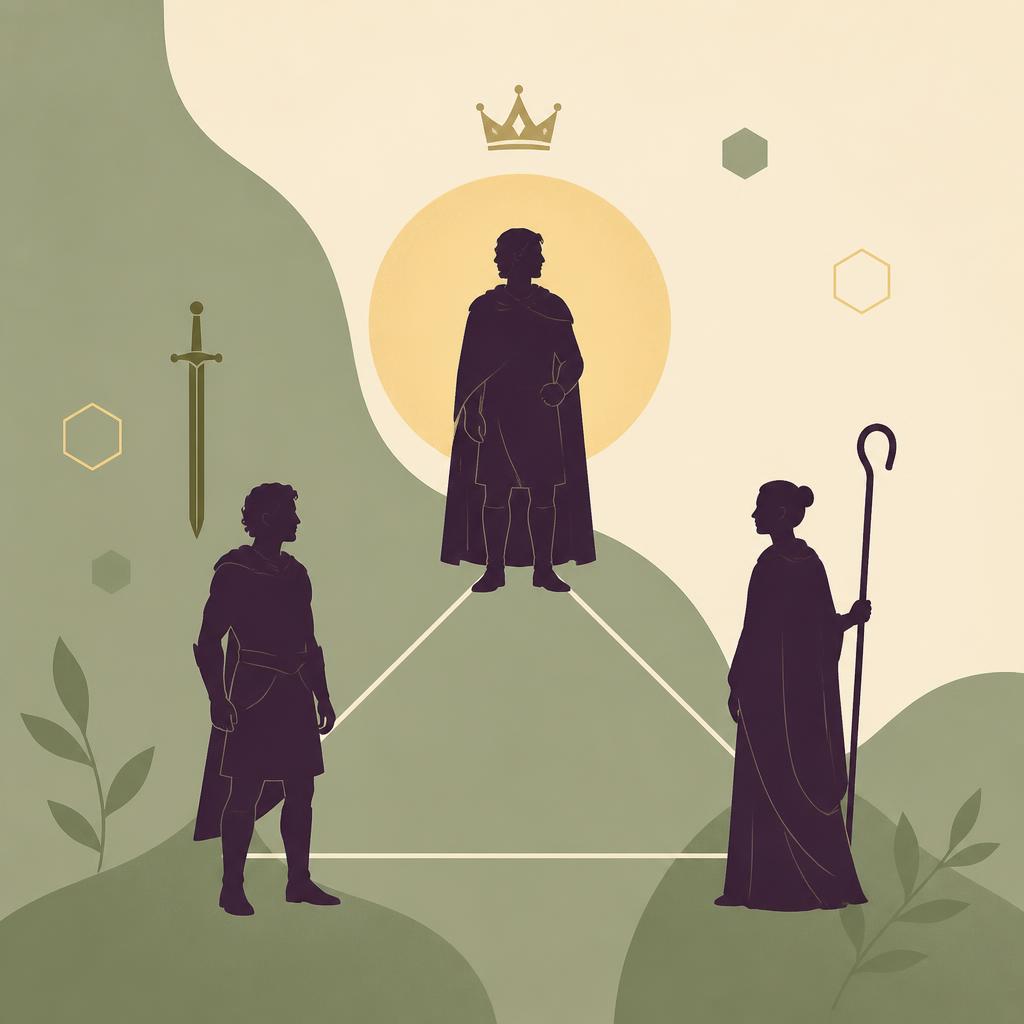
Representative leadership is the function of visibility and credibility. It means standing for the team or the organisation, both outward and inward. Korpiun symbolises it with a crown, and archetypally it corresponds to the king or the queen. This function makes sure your team is known, that its interests are represented, that there is authenticity and long term stability. In practice: it is the person who walks into a room and carries the team's reputation, who builds a network of contacts and makes sure good work does not stay invisible.
Executive leadership is the function of realisation. Its symbol is the sword, its archetype the hero, the one who knows what needs to be done and gets it done. Here sit decision making power, technical knowledge, strategy (how to get from point A to point B) and access to resources: people, time, money, knowledge. It is the function that turns ideas into results and keeps goals from quietly slipping away.
Transformative leadership is the subtlest function. Its symbol is the shepherd's staff, its archetype the shaman or the keeper of wisdom. It works with what is not visible at first glance: implicit knowledge, hidden rules, political dynamics, ambivalence and the collective memory of the team. It is the ability to influence perception and culture, to understand why people behave the way they do and to change that through meaning rather than instruction. Transformative leadership is what allows an organisation to learn and to change.
"All three functions serve the same goal: cohesion. And cohesion is never a state you win once, it is a living process, created or damaged every day in the way people talk to one another."
What happens when something is missing
The most useful part of this model is diagnostic. When one function is missing or too weak, the system starts to behave in a recognisable way, and these are patterns you have probably already seen.
- No transformative function: technocratic leadership. The organisation executes efficiently but does not learn. Everything works until a fundamental change arrives, a new technology, a new regulation, a new market, and suddenly something is needed that the organisation never learned. Functional short term, structurally fragile.
- No executive function: ineffective leadership. The team has great ideas and knows how to present them, but struggles to actually deliver anything. Vision and credibility exist, delivery stalls.
- No representative function: invisible leadership. The team may do excellent work, deliver quality, even transform itself, but nobody knows. Good work that stays unnoticed rarely gets support, resources or recognition.
Korpiun points to one systemic bias: in contemporary Western organisations the hero dominates. The executive function is the only one that receives full legitimacy, because power is measured by action and measurable results. The king and queen have almost disappeared, and the shaman, who works with meaning and the unconscious, is systematically pushed aside because it does not fit the paradigm of control. The consequence is an organisation that knows how to execute but struggles to learn and to change.
Why this matters for HR and leaders
The value of the triad is that it moves the focus from the individual to the system. Instead of asking „what are this leader's development goals”, you ask a better question: „which leadership function is underrepresented in this team and what dynamic does that produce?”
That also changes how you approach development. An imbalance is never one person's problem, it is relational. If a team lacks the capacity to learn, there is no point sending a single manager to a training; the group patterns that suppress that function need to be made visible. If a team is invisible, the question is not whether the leader is loud enough, but who in the system carries the representation function at all and why nobody takes it on.
A few practical directions
- Map functions, not titles. Go through your team and ask who actually carries visibility, who carries delivery, and who carries meaning and culture. You will often find that the formal leader covers one function while the other two are carried by completely different people, or by nobody.
- Recognise your organisational bias. If all rewards, promotions and attention go to the heroes who deliver, the transformative and representative functions are very likely weakening systemically, no matter how talented your people are.
- Treat balance as a standing task, not a one off fix. Cohesion is co-created every day. A function that is well covered today can weaken when someone leaves, when the team grows or when the context changes.
Conclusion
The leadership triad frees us from the illusion that the solution lies in finding the right person. Representation, execution and transformation, the crown, the sword and the staff, are not three personality types to hire, but three functions every healthy system has to keep in balance. When all three are present and connected, the team is visible, able to deliver and able to learn. When one is missing, the pattern shows up sooner or later.
For leaders and HR professionals who want to develop teams, this is an invitation to ask different questions, not only about individuals but about the dynamic between them. Because leadership, in the end, is not what one person is. It is what a group creates together.
References
- Berne, E. (1963). The Structure and Dynamics of Organizations and Groups. J. B. Lippincott Company.
- Korpiun, M. (2024). The Leadership Triad: A Relational Model. Transactional Analysis Journal, 54(3), 245–260. https://doi.org/10.1080/03621537.2024.2359294